

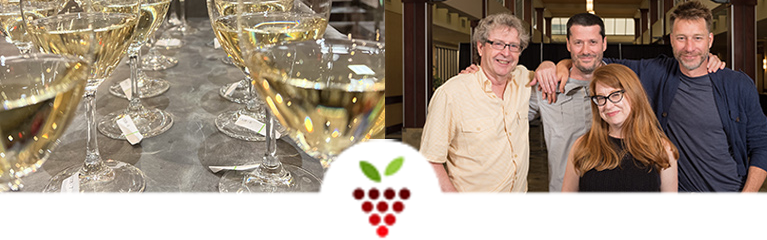

Black Hills Winery Profile
In conversation with Head Winemaker Ryan McKibbon
By Sara d’Amato
This feature was commissioned by Black Hills Estate Winery.
The deep south of the Okanagan was among the later frontiers for modern, commercial vine planting in the Valley. At the northern tip of the Sonoran Desert, this sundrenched landscape seemed suited to little more than cattle and sagebrush. Even by the 1990s, when vineyards were already established along the lake and in the cooler northern and central regions, staking a claim in the parched south looked like a gamble.
But where others saw dust and risk, visionary vintner Harry McWatters saw potential. In 1992 he planted a vineyard on Black Sage Road for his Sumac Ridge winery located in Summerland, betting that the dessert could yield something remarkable. Yet his confidence wasn’t blind faith. More than a decade earlier, the Becker Project — a pioneering viticultural study led by German viticulturists Dr. Helmut Beck of the Geisenheim Institute in Germany — had determined that even red vinifera (European grape varieties) could thrive here, in the near barren soils of the Black Sage Bench.

Black Hills Estate Winery
Caught up in the hum of new possibility on the Black Sage Bench, Senka and Bob Tennant, along with Susan and Peter McCarrell, bought an overgrown vineyard. The site, however, had pedigree: Dr. Beck’s work had already shown that red vinifera, especially the noble Bordeaux varieties, could flourish in this desert heat. The couples planted Sharp Rock and Double Black Vineyards in 1996 to cabernet sauvignon, cabernet franc and merlot, which would become the foundation of their flagship wine, Nota Bene. First crafted in 1999 with the guidance of Washington winemaker Rusty Figgins, this cabernet sauvignon-led blend quickly achieved “icon wine” status, ensuring the south Okanagan a place on the fine wine map. From there, Senka Tennant took the reins, carving out a reputation as one of the Okanagan’s pioneering winemakers. Though ownership has since passed to Andrew Peller Limited, with Ryan McKibbon now at the helm, Senka’s legacy endures.
To celebrate the 25th vintage of this iconic wine, the winery has put together two special mixed cases especially for us. Choose from the WineAlign Nota Bene Library Collection ($399+) or the WineAlign Black Hills Collector Set ($349+). These cases would be great to share with friends over the holiday season or to give as gifts.

Ontario-raised McKibbon had built an international winemaking resumé before landing at Black Hills, with experience spanning as far as New Zealand and South Africa. The opportunity to trade the gridlock of the Hamilton-Niagara commute for the solace in the isolation of the South Okanagan — and the chance to spend more time with syrah — made the move an easy choice. Adding a touch of serendipity to the Black Hills origin story, McKibbon says: “Originally they [the Tennants] were just going to plant grapes and try and sell them, but along the way this winemaker out of Washington state drove by and said, ‘you have an amazing site, you need to start making and selling that wine.’ That started Senka down the path of learning how to make wine. She knocked it out of the park in her early years and I think the quality and the potential of the site has been proven since day one.”
Just a few hundred meters across the valley lies the official sub-appellation of the Golden Mile Bench, but despite its proximity, it is a dramatically different growing environment. The Black Sage Bench sub-region on the eastern side of the Valley, although not an official appellation, is known as a “pocket desert.” It receives intense afternoon sun.
“When you turn up to the start of Black Sage Road,” McKibbon says, “you are basically on a bench of sand that carries on for many kilometres, from the heart of Oliver down to top of Lake Osoyoos, and it really allows you to farm for purity of fruit.” Out here, grapes survive thanks to irrigation; the sandy soils hold little water but plenty of potential. “Unlike Niagara where you’re fighting with drainage in clay soils, it’s a lot easier to manage vigor, under vine weeds and cover crops.”

Winemaker Ryan McKibbon
Since 2020, the winery has been farming organically, though sustainable farming has long been part of its DNA. Now, McKibbon is taking a step further, exploring regenerative agriculture techniques — simplifying farming practices to let the site speak more clearly. That means fostering ground cover and mowing rather than relying on heavy soil implements, and focusing on carbon capture and sequestration as part of a closed-loop system.
The sandy soils work in their favour: There is no battle against compaction or drainage issues, making it easier to establish healthy cover crops both between and beneath the vines. Still, the transition hasn’t been without literal thorns. Recent experiments invited an invasion of the aptly named puncturevine, a spiky barbed weed, that necessitated weeks of hand-weeding across the vineyard. It’s become an ongoing exercise in patience.
Building biodiversity is another key sustainability pillar at Black Hills, with the added benefit of helping to keep some of the more detrimental pests and diseases at bay. Leaf hoppers, cutworms and mealybugs remain a constant concern, especially with the persistent presence of leafroll disease on the Black Sage Bench. “We’re using little pockets of our vineyard that we haven’t planted with vines to try and ‘re-wild’, for lack of a better term.” Introducing (or re-introducing) sagebrush, bushgrass, antelope bitterbrush and other native species helps attract beneficial insects that can help fend off the undesirables.
Major replanting efforts began in the wake of the 2022 freeze and accelerated after the more severe 2024 event. The Black Sage Bench was one of the hardest hit of the Okanagan subregions, largely because it lacks the moderating influence of nearby lakes that temper conditions in places like the Naramata Bench or East Kelowna appellations. Without that “lake effect,” the Black Sage Bench was particularly vulnerable, especially the older 1990s plantings already struggling with leafroll in less-than-ideal locations, and, unsurprisingly, the youngest vines under five years old.
These freeze events were a bit of a double-edged sword as it has given the winery a chance to replant and make more informed viticultural decisions. After the harvest of 2023, the decision was made to remove almost all the vines and proceed with a systematic replant. “You have the opportunity to do things differently now when you’re planting and thinking of mitigating possible further extreme climatic events. We’ve taken everything we’ve learned over the past 30 years of grape growing here, flipped it all in his head, and basically created an entire new road map to our site.”

For the immediate future, the winery will lean on neighbouring vineyards to keep the portfolio flowing. “We’re relying on neighbors for the next couple of years until our vineyards are up and running again”, says McKibbon, who acknowledges that they are no longer sourcing fruit from Oregon.
McKibbon’s early experience with pinot noir and chardonnay continues to shape his ethos, even now that he’s charged with bolder, riper reds. After making careful harvest decisions, his aims to let the site speak for itself — employing gentle extraction for Bordeaux-style reds, along with wild yeast fermentation and restrained use of new oak. As he puts it, he prefers not “to bury the site and the characteristics of the wine by trying to add as little as possible without being dogmatic.” He leverages temperature control to guide native malolactic conversion, which also helps minimalize the need for sulphur and additives. “We’re not afraid to press early,” McKibbon notes, thanks to a well-developed cap-management program and constant tasting of the wine. The result is a distinctly hands-on style centered on the pursuit of balance.
In the future, we may see some more single-varietal bottlings at Black Hills as McKibbon is keen to work individually with certain Bordeaux varieties as well as wine club favourite, carmenère, along with tempranillo and, his favourite, syrah. The biggest challenge over the next few years will likely be navigating the learning curve of brand-new vineyards, some of which might start fruiting as early as next year, determining the best parcels and, ultimately, deciding how to showcase them. The team is eager for the challenge, and I can only imagine that these efforts will elevate an already impressive portfolio to even greater heights.

Black Hills Tasting Room
Yet today’s story is about Black Hill’s flagship wine, Nota Bene. This Bordeaux-style blend is an assemblage of merlot, cabernet sauvignon and cabernet franc, with the exact composition and selection of barrels varying each year to express both vintage and place. While not exactly a proprietary secret, the process reflects a non-dogmatic, small team approach. McKibbon explains “We don’t necessarily put a lot of information on the bottle, but one thing we do like to show is the blend percentage because I think that tells a story in itself,” he says. “For example, in cooler vintages you often see proportionally more merlot.” In warmer vintages, he says, merlot can be too soft. “So we can bolster it with the structure and dark fruit of cabernet.”
The newly released 2023 Nota Bene marks both the wine’s 25th anniversary and a new chapter under McKibbon’s full winemaking leadership. It’s also likely the smallest vintage in recent memory, the result of vine damage from the 2022 freeze. A blend of 37% cabernet sauvignon, 35% merlot and 28% cabernet franc — all from the Black Sage Bench — underwent wild yeast fermentation before a year of élevage in new and old French oak barrels. Following the stellar, merlot-driven 2022 vintage, the 2023 continues the legacy of quality, showcasing the strength of cabernet sauvignon. That achievement is no small feat in a year marked by inconsistent conditions, weakened vines, and wildfires — proof of resilient terroir and careful winemaking choices.
A fittingly pioneering release for this milestone year, the wine is offered both in standard and magnum formats.
To celebrate the 25th vintage of this iconic wine, the winery has put together two special mixed cases especially for us. Choose from the WineAlign Nota Bene Library Collection ($399+) or the WineAlign Black Hills Collector Set ($349+). These cases would be great to share with friends over the holiday season or to give as gifts.
You can view our team’s full review of the 2022 and 2023 Nota Bene vintage here:
Black Hills Nota Bene 2022, BC VQA Okanagan Valley
Black Hills Nota Bene 2023, BC VQA Okanagan Valley

Santé!
Sara d’Amato